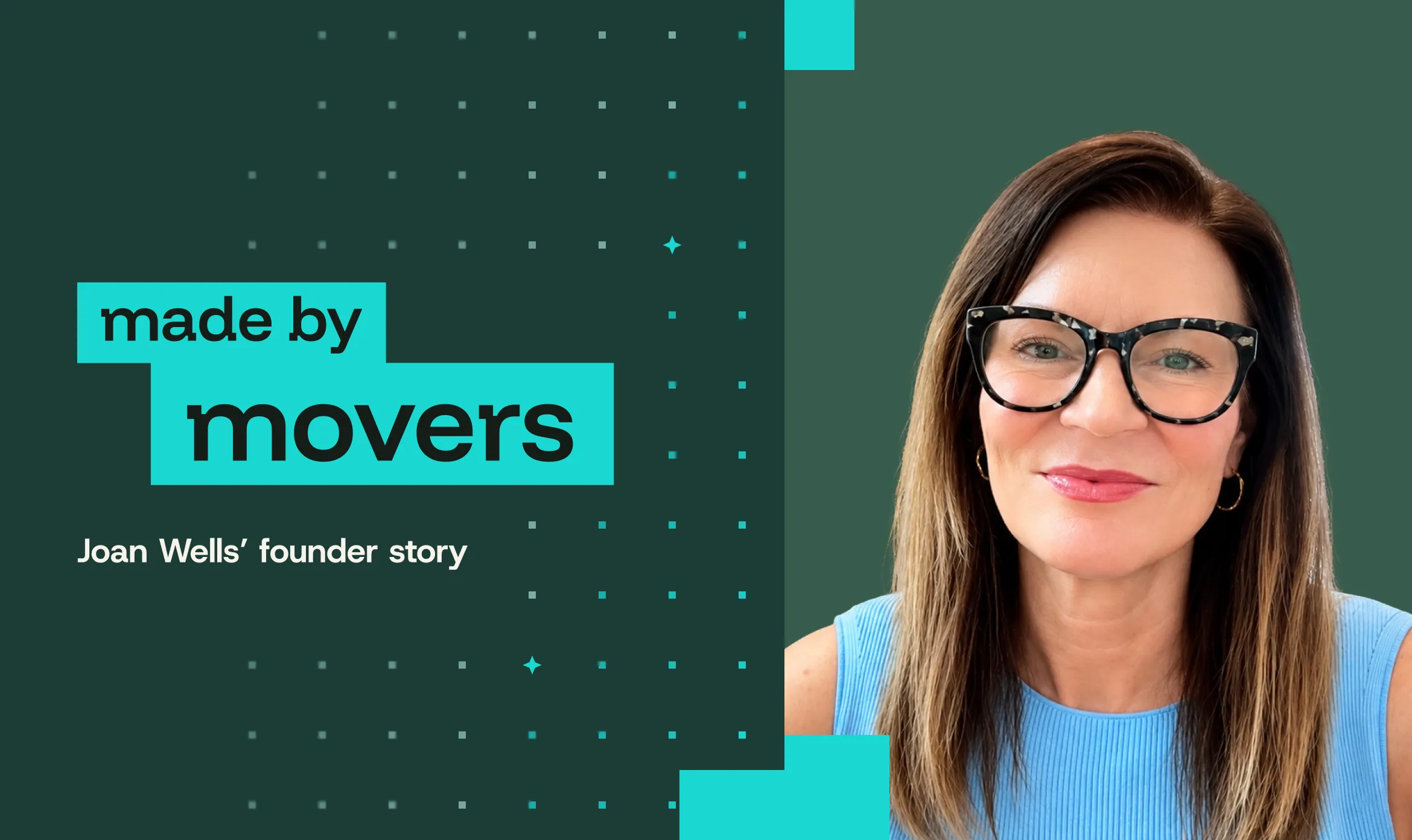
Joan Wells has spent nearly three decades building an experiential agency, and it all started with two “pink suit” moments.
One happened before she was a founder. The other made her one.
It began in a car headed to Kansas City, where five journalism students would present their capstone pitch to a room full of media executives. Their grade and graduation caps were on the line.
Feeling confident in her new pink suit, Joan and her team were reviewing the 200-page presentation book they’d spent months preparing when they discovered sections were missing and pages were out of order.
While the rest of the car worried over the book, Joan started thinking instead about the people waiting for them in Kansas City.
“Focus on the audience, not the syllabus.”
The executives cared about the pitch, the storyline, the passion and the thinking behind the ideas, and she knew without a doubt that their team knew the work. So when they arrived, they told the executives not to read the book, and they told the story instead.
Not only did her team get A’s, one of the judges contacted the dean asking for “the girl in the pink suit” and offered Joan a job.
“Before that presentation, I relied too much on information and not enough on helping people see themselves and their brand in the story. I gained the confidence to trust bold ideas, read my audience and turn conviction into action. Today, that means not relying on a 100-slide deck to sell a concept but really knowing and believing in the solutions we bring forward for clients.”
Becoming a founder
The next pink suit moment came a few years later, while Joan was working in sales at Procter & Gamble and corporate event planning was just becoming a growing industry. She saw a fit with what she knew she could do, bet on herself and started the business that would become Augeo Experience.
Early in the business, the first real test came with a chance to pitch an experience for 2,500 people, far beyond anything she had done before. What made this another pink suit moment was the presence of that same confidence in her judgment, brought to life through the bold ideas and plans for what they needed.
She won the business, bought a fax machine and built a team to pull it off. The event was a huge success.
“In my early years, I learned to lead with the strength of the idea. And that has really shaped the way I approach clients and grow my agency over the years.”
Beyond the playbook
Joan’s trust in her own judgment became the way she built and scaled the business.
She held two guiding principles: “Do the right thing, even when it is not the easy thing,” and “keep asking what comes next.” Both were tested early and often, in stretches with no obvious playbook to follow.
After 9/11, when travel stopped and clients postponed their programs, “doing the right thing” meant helping them adapt and move events forward at no extra charge. A few years later, during the recession, it meant something else: keeping every person on her team, because the diverse mix of clients and skill sets she’d built meant no single industry’s downturn could sink the whole business.
It was the only year, out of 28, that the company didn’t grow.
Then came COVID. This time, “what’s next” was the principle being tested, and Joan’s agency had already answered it. The team had spent years evolving its technology and virtual capabilities well before they became a necessity, so when live events shut down overnight, they didn’t scramble. Within two weeks, they were building across 26 virtual platforms and had become resellers for some of the industry’s largest.
“We were one of few companies in our industry that grew year over year from 2019 to 2020, and it was because we were ready.”
Audience of one
For most of Joan’s career, “what’s next?” was about finding the next way to move the business forward. Eventually the question turned inward: what did the business itself need to become?
After nearly three decades of growth, Joan and her partner were ready to accelerate it with more nimble in-house technology and greater resources for clients. They found that next step in Augeo.
“David and Juan believed that if we are bringing forward solutions to our clients now that we would have brought forward a year ago, then we are not moving quickly enough. That mindset is what I had and wanted to continue into the future.”
Today, that mindset is pushing Augeo Experience deeper into Experience Intelligence: helping organizations better understand the people, experiences and outcomes across their enterprise.
Part of that work is taking shape as the THEO Event Intelligence Engine (Evie), built by experience leaders for experience leaders. Evie brings together event data that’s scattered across an organization so teams can finally see what’s happening, what’s working and what to do next.
Better intelligence gives organizations the ability to learn from every experience and carry those insights forward into what they create next. It also takes Joan’s audience-first instinct to an entirely different scale.
An experience may bring together thousands of people, but each person moves through it individually, with their own preferences and priorities. Understanding those differences creates more opportunities to give each attendee greater choice and control over their experience.
“We are always designing experiences for an audience of one.”
The thread
Ask Joan what connects the car ride to Kansas City, the recession that never shrank her team and a platform built to know a single attendee out of thousands, and she’ll give you one answer.
“The thread that I see connecting all of those chapters in my life is really understanding people,” she says. “Building teams that are high functioning and collaborative, designing experiences that move audiences to action by meeting each attendee where they are, in a way that’s personalized and genuine.”
That instinct is still what steers Augeo Experience today, the same one that put down a 200-page book to tell the story instead.
For Joan, understanding people creates connection. It shapes how she builds teams, serves clients and designs experiences around the people in them.